





Go back to News
NEWS
Our commitment to the Sustainable Development Goals of Agenda 2030
 22 of September, 2021
As part of the week marking the 6th Anniversary of the adoption of the 2030 Agenda and the 17 Sustainable Development Goals (SDGs), a celebration promoted by the United Nations Global Compact Spain, we share the various initiatives carried out by the Firm and its Foundation as a result of the commitment we have made to this universal call to action to end poverty, protect the planet and reduce inequalities.
As members of the Spanish Global Compact Network, we work especially hard to achieve SDG16 “Peace, justice and strong institutions”, which seeks to promote just, peaceful and inclusive societies for sustainable development, as well as to facilitate access to justice for all and build effective, accountable and inclusive institutions at all levels.
This is also the case of our foundation, the Fernando Pombo Foundation, which contributes specifically (but not only) to SDG16 target 3 “Promote the rule of law at the national and international levels and ensure equal access to justice for all”. The Foundation was founded in 2010 with the aim of improving the lives of the most vulnerable through law.
We contribute to the SDG16 in various ways, including the pro bono projects we carry out through the Fernando Pombo Foundation. We focus on identifying and eliminating barriers and legal loopholes that affect access to and enjoyment of the fundamental rights of the following population groups in situations of special vulnerability with which the Firm and the Foundation consider it a priority to work:
– Victims of gender-based violence
– Victims of human trafficking
– Children with health problems and in social exclusion
– Homeless people
– Forced migrants
With this illustrative infographic we show our involvement and commitment to the 17 Sustainable Development Goals (SDGs), insofar as we care and take action by respecting the planet, promoting initiatives that contribute to supporting the community, caring for our main asset, people, and seeking responsible business formulas.
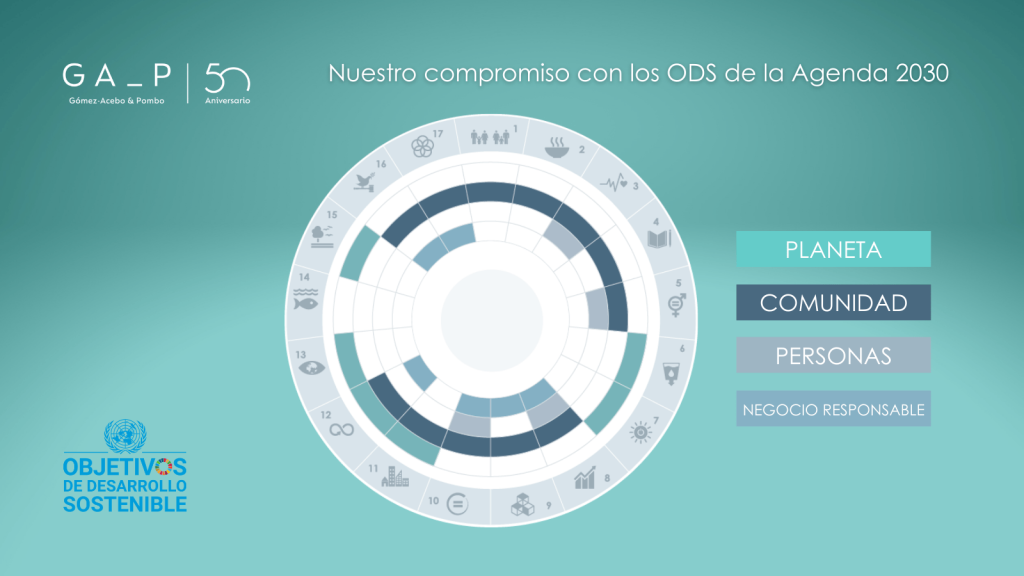
As members of the Spanish Global Compact Network, we work especially hard to achieve SDG16 “Peace, justice and strong institutions”, which seeks to promote just, peaceful and inclusive societies for sustainable development, as well as to facilitate access to justice for all and build effective, accountable and inclusive institutions at all levels.
This is also the case of our foundation, the Fernando Pombo Foundation, which contributes specifically (but not only) to SDG16 target 3 “Promote the rule of law at the national and international levels and ensure equal access to justice for all”. The Foundation was founded in 2010 with the aim of improving the lives of the most vulnerable through law.
We contribute to the SDG16 in various ways, including the pro bono projects we carry out through the Fernando Pombo Foundation. We focus on identifying and eliminating barriers and legal loopholes that affect access to and enjoyment of the fundamental rights of the following population groups in situations of special vulnerability with which the Firm and the Foundation consider it a priority to work:
– Victims of gender-based violence
– Victims of human trafficking
– Children with health problems and in social exclusion
– Homeless people
– Forced migrants
With this illustrative infographic we show our involvement and commitment to the 17 Sustainable Development Goals (SDGs), insofar as we care and take action by respecting the planet, promoting initiatives that contribute to supporting the community, caring for our main asset, people, and seeking responsible business formulas.

Press contact

Director of Business Development, Marketing and Communications


Director of Business Development, Marketing and Communications

More information about
Gómez-Acebo & Pombo

 09 Sep, 2026

PUBLICATION
 18 Sep, 2026
Resolved bank’s liability as pledgee of third-party owned shares in the bank
The fiduciary nature of the managed investment relationship supports the view that the bank should be liable for the loss of the pledged item because there would not have been such loss had the client’s order been executed prior to the bank’s resolution — but not for the reason given in the judgment.
18 Sep, 2026 
PUBLICATION
15 Sep, 2026
Sale of essential assets without shareholder approval and the enforceability of such violation against third parties
The Supreme Court (Judgment no. 881/2026 of 9 June) has held that Article 234(2) of the Companies Act is applicable by analogy in a case where a company director disposed of essential company assets without the required authorisation from the shareholders in general meeting (Art. 160(f) of the Companies Act).
15 Sep, 2026
PUBLICATION
11 Sep, 2026
Emails sent by a company to its staff during collective bargaining do not always violate freedom of association
Emails sent by a company to its staff during a negotiation process do not, in and of themselves, constitute anti-union interference or unlawful pressure, provided they fall within the scope of the company’s freedom of expression and the legitimate defence of its business interests.
11 Sep, 2026
PUBLICATION
11 Sep, 2026
Public consultation now open on the Royal Decree regulating the requirements for energy sustainability, environmental sustainability, digital resilience and digital sovereignty applicable to data centres
11 Sep, 2026
PUBLICATION
11 Sep, 2026
Agreement offsetting leasehold improvements against future commercial lease payments: third-party purchaser takes the stage
Is a set-off agreement enforceable against a purchaser seeking to collect new lease payments? Although the answer is not clear-cut, ultimately the lessee will not leave without compensation for the improvements
11 Sep, 2026
PUBLICATION
31 Jul, 2026
Automotive and Sustainable Mobility No. 31
Summary of legislative and jurisprudential developments relating to the automotive sector.
31 Jul, 2026
PUBLICATION
28 Jul, 2026
Derogations from the principle of supervision in the home Member State in respect of information society services and control over content by means of an algorithm
The Court (Grand Chamber) defines the scope of derogations from the principle of supervision in the home Member State for information society services on grounds of public policy, security and safety, clarifying the distinction between general prohibitions and individualized measures directed at specific providers. It also provides important criteria regarding the liability of digital platforms, holding that control exercised by means of algorithms may preclude the application of the exemption from liability provided for data hosting services.
28 Jul, 2026
PUBLICATION
23 Jul, 2026
New regime for giving international effect to judicial sales of ships
UN Convention on the International Effects of Judicial Sales of Ships establishes a mechanism to ensure that judicial sales of ships which confer clean title in the State Party in which they are conducted produce the same effect in other State Parties without bureaucratic obstacles that hinder trade in this sector.
23 Jul, 2026
PUBLICATION
22 Jul, 2026
Shipowner and package travel organiser: on whether the limitations of liability under the Athens Convention apply
The matter at issue is whether the shipowner, which provides a passenger transport service as part of package travel organised and sold by a travel wholesaler or retailer, may invoke the limitations of liability specific to maritime transport against the tourist and against the organiser; but, above all, whether the organiser may also invoke them against its client.
22 Jul, 2026