





Go back to News
NEWS
Gómez-Acebo & Pombo recognised at the Global Pro Bono Awards 2021
 21 of October, 2021
The Global Pro Bono Awards ceremony took place yesterday, where the two projects presented by our Foundation, Online Gender-Based Violence and Primero H Socimi, were recognised in the prestigious awards of PILnet (Public Interest Law Network), a global organisation of reference in the promotion of legal pro bono. These awards recognise projects from all over the world in which leading international law firms participate.
The Online Gender-Based Violence project has been awarded as the best project in the Local Pro Bono Impact category and thus becomes the first Spanish pro bono project to obtain this award.
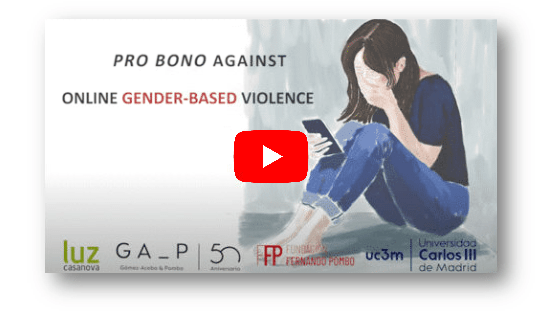
Through this project, the Foundation together with the Law Firm, the Luz Casanova Foundation and the Carlos III University of Madrid, want to contribute to improving knowledge and legal assistance in gender-based violence by digital means among adolescents. To this end, a practical legal guide and an information leaflet for adolescents have been created and will be presented on 23 November at the Firm.
The project team was formed by Patricia Fita, Ana Higuera, Alejandra Martín, Marina Martín, Rafael Merino and Carmen Pombo (for the Foundation) and Carlos Álvarez, María Rosa Garrosa, Teresa Gutiérrez, Inés Fontes, Saray López, Inés Molina, María Flora Morillo-Velarde, Borja Ramos, Marta Robador, Inés Puig-Semper, Irene San Martín, Ralph Smith and Beatriz Vivar (for the Firm).
For its part, the Primero H Socimi project, which has been shortlisted, is a large pro bono collaboration project for the constitution of the first social SOCIMI in Spain, created by ASOCIMI and HogarSÍ, with the support of Andersen, our Firm and our Foundation.
The aim is to develop 177 homes in three years, mainly for homeless people.
On this occasion, the team was made up of Patricia Fita, Ana Higuera, Marina Martín, Rafael Merino and Carmen Pombo (for the Foundation) and Enrique Isla, Oliver Padilla, Jacobo Palanca, Augusto Piñel and Javier Vinuesa (for the Firm).

These awards, which enjoy great recognition worldwide, are a benchmark in the practice of pro bono, so this award is an honour for the Firm and the Foundation of which we are very proud.
Thank you very much to all of you for your commitment and collaboration in these initiatives that are so necessary for social progress.
CONGRATULATIONS!
The Online Gender-Based Violence project has been awarded as the best project in the Local Pro Bono Impact category and thus becomes the first Spanish pro bono project to obtain this award.
Through this project, the Foundation together with the Law Firm, the Luz Casanova Foundation and the Carlos III University of Madrid, want to contribute to improving knowledge and legal assistance in gender-based violence by digital means among adolescents. To this end, a practical legal guide and an information leaflet for adolescents have been created and will be presented on 23 November at the Firm.
The project team was formed by Patricia Fita, Ana Higuera, Alejandra Martín, Marina Martín, Rafael Merino and Carmen Pombo (for the Foundation) and Carlos Álvarez, María Rosa Garrosa, Teresa Gutiérrez, Inés Fontes, Saray López, Inés Molina, María Flora Morillo-Velarde, Borja Ramos, Marta Robador, Inés Puig-Semper, Irene San Martín, Ralph Smith and Beatriz Vivar (for the Firm).
For its part, the Primero H Socimi project, which has been shortlisted, is a large pro bono collaboration project for the constitution of the first social SOCIMI in Spain, created by ASOCIMI and HogarSÍ, with the support of Andersen, our Firm and our Foundation.
The aim is to develop 177 homes in three years, mainly for homeless people.
On this occasion, the team was made up of Patricia Fita, Ana Higuera, Marina Martín, Rafael Merino and Carmen Pombo (for the Foundation) and Enrique Isla, Oliver Padilla, Jacobo Palanca, Augusto Piñel and Javier Vinuesa (for the Firm).
These awards, which enjoy great recognition worldwide, are a benchmark in the practice of pro bono, so this award is an honour for the Firm and the Foundation of which we are very proud.
Thank you very much to all of you for your commitment and collaboration in these initiatives that are so necessary for social progress.
CONGRATULATIONS!

Press contact

Director of Business Development, Marketing and Communications


Director of Business Development, Marketing and Communications

More information about
Gómez-Acebo & Pombo

 09 Sep, 2026

PUBLICATION
 18 Sep, 2026
Resolved bank’s liability as pledgee of third-party owned shares in the bank
The fiduciary nature of the managed investment relationship supports the view that the bank should be liable for the loss of the pledged item because there would not have been such loss had the client’s order been executed prior to the bank’s resolution — but not for the reason given in the judgment.
18 Sep, 2026 
PUBLICATION
15 Sep, 2026
Sale of essential assets without shareholder approval and the enforceability of such violation against third parties
The Supreme Court (Judgment no. 881/2026 of 9 June) has held that Article 234(2) of the Companies Act is applicable by analogy in a case where a company director disposed of essential company assets without the required authorisation from the shareholders in general meeting (Art. 160(f) of the Companies Act).
15 Sep, 2026
PUBLICATION
11 Sep, 2026
Emails sent by a company to its staff during collective bargaining do not always violate freedom of association
Emails sent by a company to its staff during a negotiation process do not, in and of themselves, constitute anti-union interference or unlawful pressure, provided they fall within the scope of the company’s freedom of expression and the legitimate defence of its business interests.
11 Sep, 2026
PUBLICATION
11 Sep, 2026
Public consultation now open on the Royal Decree regulating the requirements for energy sustainability, environmental sustainability, digital resilience and digital sovereignty applicable to data centres
11 Sep, 2026
PUBLICATION
11 Sep, 2026
Agreement offsetting leasehold improvements against future commercial lease payments: third-party purchaser takes the stage
Is a set-off agreement enforceable against a purchaser seeking to collect new lease payments? Although the answer is not clear-cut, ultimately the lessee will not leave without compensation for the improvements
11 Sep, 2026
PUBLICATION
31 Jul, 2026
Automotive and Sustainable Mobility No. 31
Summary of legislative and jurisprudential developments relating to the automotive sector.
31 Jul, 2026
PUBLICATION
28 Jul, 2026
Derogations from the principle of supervision in the home Member State in respect of information society services and control over content by means of an algorithm
The Court (Grand Chamber) defines the scope of derogations from the principle of supervision in the home Member State for information society services on grounds of public policy, security and safety, clarifying the distinction between general prohibitions and individualized measures directed at specific providers. It also provides important criteria regarding the liability of digital platforms, holding that control exercised by means of algorithms may preclude the application of the exemption from liability provided for data hosting services.
28 Jul, 2026
PUBLICATION
23 Jul, 2026
New regime for giving international effect to judicial sales of ships
UN Convention on the International Effects of Judicial Sales of Ships establishes a mechanism to ensure that judicial sales of ships which confer clean title in the State Party in which they are conducted produce the same effect in other State Parties without bureaucratic obstacles that hinder trade in this sector.
23 Jul, 2026
PUBLICATION
22 Jul, 2026
Shipowner and package travel organiser: on whether the limitations of liability under the Athens Convention apply
The matter at issue is whether the shipowner, which provides a passenger transport service as part of package travel organised and sold by a travel wholesaler or retailer, may invoke the limitations of liability specific to maritime transport against the tourist and against the organiser; but, above all, whether the organiser may also invoke them against its client.
22 Jul, 2026